Friday, June 18, 2010

Here's Why This Latest Wave of New York Startups is Just the Beginning

[Also published in the Business Insider]

Once again, there is a renewed sense of enthusiasm about the New York City startup community. Today we are seeing a major influx of high-quality entrepreneurs moving here—or back here. The quality of company formation has never been higher, and there are a variety of reasons for this.

Perhaps most obvious is that New York City has always been a place where people want to live, and today is no exception. There are two additional factors now driving New York’s increasing popularity among aspiring, sophisticated entrepreneurs. First, the general trend toward capital efficiency, and second, what I call the horizontalization of information technology.

Capital efficiency means that more companies can afford to move to New York if they choose. A variety of dramatic cost-reducing realities have lowered the fixed-cost of building a software or web startup by an order of magnitude. At the top of the list are the rapidly advancing technologies of open-source software and cloud computing. As a result, some of the hardware and support-system costs (such as large staffs of IT personnel and extensive real-estate footprints) once associated with operating in New York simply do not apply in this new environment.
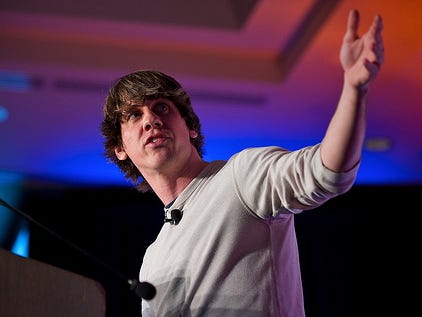
Dennis Crowley at Where 2.0
Dennis Crowley, founder of Foursquare

Horizontalization is more nuanced. The technology industry has been a standalone industry throughout most of its history, a vertical that stood alongside other large industries. Today, technology is becoming more of an integrated portion of the existing stacks—or the distinct components of hardware, middleware and software required to operate entire IT infrastructures—within businesses rather than a separate vertical industry. As a result, essentially all industries—including the seven industries headquartered in new York—are increasingly able to make use of the lower-cost, better-integrated information technology that open-source software, cloud computing and related innovations are enabling.

With this evolution comes a striking change in calculating the optimal location for technology businesses. It is simply no longer true that technology companies must be located near technology centers. Today, the optimum strategy often puts these companies near business centers, where the customers are. Few business centers in the world are as central as New York City. No matter where something is invented or produced, it is sold here.

michaelbloomberg
Michael Bloomberg, the city's most successful digital entrepreneur

Outsiders may see this accelerating startup activity in New York as a new phenomenon, but those of us who have been active within the local startup community since its revitalization in the early 1990's have a different view. I regard this latest surge in activity as yet another wave in an impressive chain of entrepreneurship that is rooted in the long history of New York City.

New York’s place as a fountain of entrepreneurial activity—and why it appears to hold even more potential today -- cannot be properly understood without a fundamental appreciation of the region's rich tradition of entrepreneurship and commerce. A look at the past can provide important clues that help make sense of the present. Moreover, I believe that this 400-year history provides vital context for informing the conversation now taking place about the technology community in New York today, and for further building the entrepreneurial ecosystems to nourish it.

The Beginning

Before there was New York City, there was New Amsterdam, and it didn’t start with the Puritans. The Dutch West India Company deposited 100 people on the shores of what would later become New York City back in 1624. All were entrepreneurial, pragmatic, money-seeking traders who didn't much care for rules. Two years later, Peter Minuet bought Manhattan for an infamous $24 in trinkets, from Indians who did not live here. And so it began—a portentous new outpost of western civilization, literally created over a deal.

Peter Minuet, Manhattan
Peter Minuet buys Manhattan for $24.

The area has a long history of what I call an entrepreneurial class; these are individuals for whom an “off-the-rack” life does not suffice. The tinkerers, the inventors, the merchants who believe they alone have the instincts, skills and chutzpah to reinvent the world around them have always been drawn to this city. There was a reason those Dutch men and women got on the boat almost four hundred years ago, and it had little to do with religious persecution. These were the first New Yorkers, and they were entrepreneurs.

From the earliest days, waves of entrepreneurial activity have advanced the local economy here. These waves sometimes were manifested in completely new arenas, other times through the deployment of technologies within existing businesses. Yet the drumbeat always remains the same: Maturing industries experience a talent drain in favor of more entrepreneurial endeavors. First a trickle, then a steady downpour. Eventually, maturation leads to consolidation and scale, and the process is repeated. Some of the more important entrepreneurial waves in New York City and its immediate surroundings have included fur trading, timber, sugar refining, shipbuilding, tobacco, banking, canals, railroads, clothing, textiles, electricity, media, entertainment, advertising, communications, fashion and a long list of other industries that have come and gone with the passage of time. Today, seven industries remain headquartered in New York, and all are undergoing rapid technological transformation.

New York Banking is Born

In the latter part of the 18th century, New York banking was born with the founding of the Bank of New York. Within a dozen years many more banks followed, new services were devised, and trading—previously the passion of a few dedicated risk-takers huddled under a buttonwood tree in lower Manhattan—coalesced in the form of the New York Stock Exchange. These new institutions—and their product-creation engines—would finance entirely new industries on a national level. Men such as Hamilton, Burr, Morgan, Goldman, Drexel and many others less well-known were, if you will, the Bill Gateses and Michael Bloombergs of their day. All this activity in financial services was in part dependent on two unrelated technological transformations: communication through newspapers, and over wires.
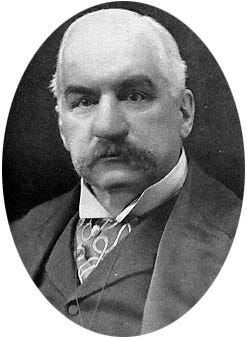
JP Morgan portrait
J.P. Morgan

Newspapers Begin to Drive Information & Advertising

Although newspapers of one sort or another had been around for some time, they were generally small, highly localized and very partisan. The ability to rapidly and broadly disseminate information was still new to the world even at the turn of the 20th century. (The New York Times, itself founded in 1851, was one of the earliest papers to go national, but that didn’t happen until several decades after its first editions were printed.) It was the commercialization of the electrical telegraph, which occurred in the mid-19th century, that enabled the transformation of newspapers through a localized method for disseminating news. This new technology reduced the time it took for a letter or news story to travel across the country from weeks to minutes, making it possible to provide more complete information. Today, of the three national papers sold in the United States, two are published from New York. (New York currently boasts about 270 newspapers printed in 40 languages.)
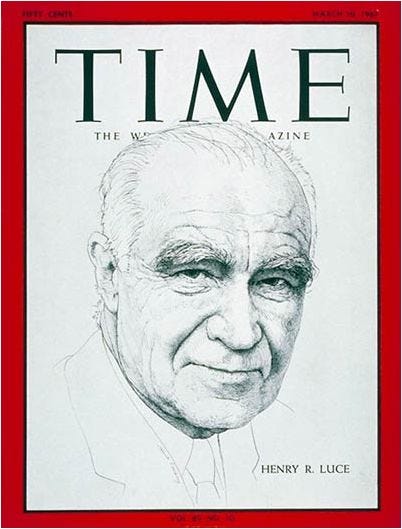
Henry Luce
Henry Luce, founder of Time.

With the rise of the newspaper—and later—the magazine, advertising soared as a new business model developed by entrepreneurs and merchants to promote their wares to a larger customer base. Erickson, McCann, Thompson, Rubicam, Barton, etc., all founded their eponymous firms between the late 19th and early 20th centuries, and all in New York. Many grew rapidly through acquisition, rolling up smaller, entrepreneurial firms whose ranks had surged from roughly a dozen in mid-century to several hundred by the 1920s. Nearly one hundred years later, seven of the eight largest advertising firms in the world reside in New York.

NYC: The Land of Entertainment

Entertainment was dominated by New York from its earliest days. Vaudeville—and later, Broadway—was an industry populated by highly competitive entrepreneurs. Since news and advertisements sold tickets, and ticket sales meant profit, the unique combination of the media, advertising and banking industries stoked the rapid growth of this form of entertainment. It helped of course to have a rapidly-growing middle class with the time and money to take in these productions. You probably can guess from where much of this early audience hailed. In time, new technologies like radio, and later film and television, would transform forever the nature of entertainment. Much of the production and eventually the creative arms of the entertainment industry as we know it today moved to Los Angeles, primarily for weather-related reasons. Still, even now, all four major TV broadcasters, many of the largest cable channels, and three of the four biggest record labels are based in New York. One-third of all Indie movies are still made here, and an incalculable number of TV shows.

Content Needs to be Distributed: The Birth of Communications

Since content in one form or another was the product of all these New York-centered industries, it was logical that the media for distributing it and the input technology for enabling it (electricity) needed to be located nearby. And it was. Entrepreneurial businesses such as The New York & Mississippi Valley Telegraph Company (now known as Western Union) were created here. The Edison General Electric Company (which ultimately became General Electric) was established by Thomas Edison a few miles southwest of lower Manhattan, in Menlo Park, N.J. In fact, the first commercial power station ever built was on Pearl Street in lower Manhattan.
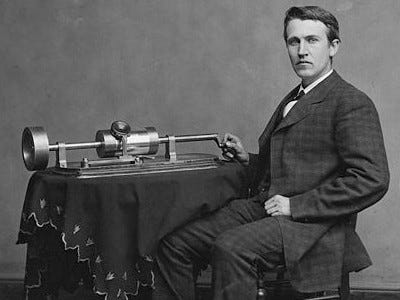
Tom Edison Wikipedia
Thomas Edison

Dozens of related startup businesses also were founded in and around New York City, although for reasons of cost, space and safety, many followed Edison’s lead and conducted most of their research in nearby New Jersey. Much of the telecommunications infrastructure we rely on today at a global level has grown from innovations created and still in development just south and west of New York City. While rising labor costs and other factors have long since curtailed local manufacturing significantly, research and development, and the management of existing corporate infrastructure, are still based here.

NYC in 2010: Commerce Comes Full Circle

As I stated earlier, New York is home to at least seven global industries: finance, media, publishing, advertising, communications, retail, and fashion. More than 10 percent of the Fortune 500 are headquartered in or near New York City; a greater percentage than any other location in the United States, including all of California. The City is also the most international city in the U.S. (and not just because the U.N. is located here) as measured by immigration, diversity, trade, representation, tourism, languages, population, religious views, quantity of international flights, unpaid parking tickets by country, and so on. Nearly one-third of New York Metro residents are immigrants, even today. It also is one of the leading cultural capitals of the world, with a cornucopia of diverse artistic, intellectual, ethnic and religious offerings. Millions of people consider New York City one of the world’s great places to live. This is despite the inherent challenges associated with nearly 20 million people living within a relatively small geographic area, or the equivalent of one of every 16 people in the United States.

Ben Lerer 300x200
Ben Lerer, founder of Thrillist

It is against this backdrop that New York’s entrepreneurial class is again rising. The earliest signs of this resurgence appeared in the 1980s, when entrepreneurs like Michael Bloomberg grasped the transformational nature of computer technology on financial services. Throughout the 1990s, many non-financial entrepreneurs left their posts at the region’s major media conglomerates in search of new opportunities utilizing the latest technologies. Compact disks were the first of these new technologies, then came the rise of the Internet. Early winners such as N2K, DoubleClick, 24/7 Media, About.com, TheStreet.com and ScreamingMedia emerged, creating a groundswell of new activity.

At the same time, already-strained technology budgets were pushed into overdrive in the face of widespread concerns over Y2K disruptions. Enterprises spent even more heavily, upgrading their IT systems before the clock rolled over to the year 2000, on top of large budget commitments already underway to embrace the new age of the Internet. New York experienced this so-called “dot-com boom” in step with the rest of the developed world, but with a decided bias towards media and entertainment. The bursting of the dot-com bubble dealt a temporary setback to New York’s entrepreneurial community, yet the transformational nature of new technology was not stalled for long. Today New York is embarking on the second half of what undoubtedly will be seen as a massive resurgence of entrepreneurial activity, extending perhaps for another twenty years. None of this implies that there won't be periods of indigestion as various bubbles inflate—and burst—within different technologies and industry sectors, but the fundamentals are in place.

So why is New York so well-positioned this time around? The key factors are: 1) the industries anchored here; 2) the tectonic shifts occurring within those industries, based largely on technological advances; 3) personnel dislocations; and 4) the propensity of the companies within those industries to spend aggressively on technology. For example, global IT spending within financial services is around $550 billion, annually. Communication spending on IT is about $400 billion. Retail’s share is around $150 billion. And so on. In total, companies within these and other industries are projected to make spending decisions on close to $1 trillion in technology—every year—for the next decade or two. Of course, the majority of deployments generated by these purchases will not occur within the New York area; most happen across the decentralized global organizations of major corporations, and the varied locations of smaller businesses. Yet many of the decisions will be made here. And many of the decision-makers will be impacted by the entrepreneurial class, whether in developing and procuring new products and services, or by being recruited into start-ups.

The New York-centric news media will continue to closely monitor and report on the media-related start-up culture within the region. This coverage will dominate relative to what is reported on the start-up activity in other major industries. This is natural, given the impact of media innovation and commercialization on the news media’s own rapidly evolving industry. But make no mistake: The revolutionary benefits—and consequences—of accelerating entrepreneurial activity will have a major impact across all NY-based industries, both foundationally (e.g. broadband deployment, elastic computing, spectrum optimization), and at the higher layers (real-time webs, complex data visualization, semantic analyses, mobility, location-aware services, exchange platforms, big data modeling, and a cornucopia of other technologies).

When all the pieces are put together, the reasons behind today’s surge in pathbreaking New York start-ups are easy to grasp. New York remains one of the world’s greatest and most livable cultural centers. It has a diverse core of seven global industries competing aggressively, increasingly through technology. A new set of lower-cost economics is enabling technology providers to operate closer than ever to business centers such as New York. And New York is attracting a widening pool of talent for start-ups that is highly motivated. This latest wave in the long, storied history of entrepreneurship in New York is only getting started.

Saturday, June 5, 2010

Populist blather is approaching a high-water mark

Populism is fueling a vitriolic debate around Carried Interest tax 'reform', as demonstrated by the comments over at Chris Dixon's blog. It can feel good to go off on extreme examples like Steve Schwartzman eating $400 crabs, but it's important to think through what will really happen if this legislation actually becomes law.

Tax policy as it relates to finance and investment activities in the U.S. has as its primary goal the provision of incentives / disincentives based on 'preferential' activities. It is about incentivising behavior, not some individualized and debatable construct of fairness. Preferential activities are defined as long-term investments that promote real GDP as opposed to short-term trading with zero-sum outcomes. As a nation we have decided the correct metric is 365.

So, the question is, do we want to revise the incentives, and if so, how? Changing the policy on 'carried interest' will, in fact -- and with all due respect to my friend Fred Wilson's hypothesis -- impact the flow of commitments into venture capital, private equity, leveraged buyouts, oil & gas, real estate, and just about every other partnership-based investment alternative out there. This will happen at least two ways...

First, these asset classes will be less profitable. Why? Because some of these newly-imposed 'costs' will be shared by the limited partners, reducing total returns for them -- and their respective asset classes. It is naive to believe that only GP's will be affected. This will spark an exercise in reallocation analysis, and a flight to 'perceived' quality for those dollars that remain committed.

Here's what you will end up with... Fewer, larger 'marquis' firms with more pricing power, synthetic 'structures' that echo current LP economics but somewhat divorce term enforcement (more on this below), and tougher deals for entrepreneurs (the mid-range firms with only moderate power will be most at risk, yet it is precisely this group that creates the competitive dynamic that startup companies have enjoyed in recent years).

Second, fund mangers will certainly come up with creative structures (never forget the laws of unintended consequences, Idealism's frequently-fatal flaw) that traverse legal roadblocks while dissaligning shared incentives within the core investment activity. In other words, 'carried interest' will go away, replaced by some form of partner-based ownership (most likely same as common stock) on a deal-by-deal basis. Now, take a moment to think about that... and then think about future financing events, board representation, even deal selection - and the inherent conflicts of interest therein. Turning a performance compensation mechanism into an owned option difficult to claw back will certainly not be in the interests of either startup companies or LP's (or the pensioners, endowments etc., that comprise them).

In sum, reducing the normalized return differential between common alternative asset classes and ordinary market investing - and thus altering the perceived risk-profile - will have real dollar consequences, make no mistake. Think you dislike hedgies now? Wait until a quarter of alternative assets pour into their coffers.

Moreover, it will significantly alter deal structures creating further chasms between funders and founders. And by the way, at least in the last ten years (as it relates to VC anyway) had this Bill been in effect, your US Gov tax bounty would have rounded to, um, essentially zero.

Couple of other points on this Carried Interest tax question....

1) As for Carried Interest being a 'fee', it's a performance override (and in no way definable as 'revenue'). Any payment -- performance-based or otherwise -- is ultimately 'describable' as a fee. The question isn't the nomenclature, it's in the certainty and timeliness of the payment, and the underlying asset that generated it. If it's under 365, then it's short-term. If it's directly attributable to the increase in value of a long-term asset, that's materially different than a tip for a job well-done.

2) Every successful VC I know could earn a multiple of their current salaries in other (and not necessarily so different) businesses; they choose to trade off substantially lower current economics (about 5:1 by my calculation) for even higher future earnings potential. But that's just what it is.... potential. Implicit in this contract is a larger piece of the pie and a cap gains tax-rate on value-creation in exchange for the assumption of this risk. Take away the tax benefit and VC's will be more risk-averse, not less. It is also ridiculous to suggest that the best people will stay in venture capital 'because they love it' despite substantially-diminished economics. Seriously?

3) As has been pointed out by others like Jeff Bussgang, quite a few of us in this business are ourselves entrepreneurs, having built successful, long-term venture capital businesses. We risked our capital, security and futures to chart our own course. But VC firms do not have exit opportunities like the startups in which they invest. We know that going in, so it's okay as long as alternative paths to wealth creation remain. You can count on two hands the number of firms that have sold or gone public since the dawn of this industry some fifty years ago -- and on one hand the number that have actually been successful at it. That's maybe half a percent; a tiny fraction of the transaction rate startup companies enjoy.

In the end, I prefer a system that rewards long-term value creation over the casino that is Wall Street. And my viewpoint may surprise you, in that I, too, believe that there is a difference between investing a dollar from my own pocket versus a dollar managed that came out of yours. Which is why I think the long-term gains rate should be revised down, to 10% for a principal's money, 20% for OPM override earned beyond a 12-month period (up from 15% today), and then the rest at short-term rates. This in my view achieves the all-important goal of delivering proper incentives for long-term investment over short while being a 'fairer' system. Bear in mind that despite all of the derision around OPM, most all businesses - including most startups - use it to build value. In the end, all of us are 'stewards' for someone else's money, one way or another. The economy doesn't care from whose actual pocket it's long term dollars come. Nor do entrepreneurs.

VC-as-bogeyman is a popular meme at the moment, and I can't say it isn't somewhat justified. That said, babies and bathwater come to mind, and, unfortunately, heart-felt but unexamined populism rarely leads to better policy. It's not supposed to; rather, it's highest and best use is to stir debate. The current carried interest Bill will do little more than hurt the startup ecosystem while raising a de minimis amount of tax revenue.

Saturday, April 17, 2010

Vision, or blindness?

David Fisher once wrote...

“What often characterizes visionaries is their lack of vision. It's a popular idea that people of genius see farther and clearer than other people, but perhaps the truth is actually the opposite. Visionaries often don’t notice the enormous and obvious impediments to realizing their technological dreams – roadblocks apparent to more practical people”.

I think he makes an excellent point, as relevant today as at any time in history. Maybe more so.

Saturday, March 27, 2010

As a species, we almost always over-estimate how fast things will change. But we always underestimate how much things will change. Thus….

My ten predictions before the world is slated to end in Dec. 2012....

·10) Eric Schmidt will no longer be CEO of Google. As giant media foes attempt to absorb excess profits in part derived on the backs of their content, things will get sticky. Eric will grow weary of the countless battles, stock price pressure, and growing discord in the senior ranks. One key factor? Bing. Why? Well, it’s like Pepsi, or Burger King. As Americans we are comfortable with virtual oligopolies, but not monopolies. We require an alternative to Coke and McDonalds. Yahoo by itself has failed at being that alternative. On the other hand, if there is one company that can challenge Google’s hegemony with pockets every bit as deep, it is Microsoft. Forget whether you think Bing is ‘better’ or ‘worse’ – irrelevant. It is a credible substitute, and it will be used by major media to try and squeeze Google’s profits. Which leads me to my next prediction….

·9) Paid search and natural search will become…. Search. We have grown comfortable in the knowledge that those slippery marketers are relegated to the internment camps of the paid section of search pages. But users really don’t care – what they want are good results – paid or not. The state-of-the-art today for paid results has them look and feel just like the real thing. Which they often are. In the near future, result hierarchy will be, in part, based on pay - but pay for performance - not just ranking. The gotchas leading to pay-walls and other poor user experiences will sink in the listings no matter the dollars thrown at them, in favor of a single search stream where dollars will play a role (but not the only role) in influencing rank. And this will happen in real-time!

·8) Steve Jobs and Apple will go one of two ways, and neither is great (but one is decidedly better than the other). In scenario 1, Jobs is permanently sidelined due to illness. To my memory, there has never existed a major corporation more personality-dependent than Apple (at least in modern times – I put him up there with Howard Hughes). Thus, within a very short period of time the brilliant, legendary, maniacal focus he possesses will be lost, and decisions that appear to be ‘better’ for the organization and its products will be made. These half-steps will be compromises designed to keep up with the world while preserving Steve’s ‘legacy’. This will not go well.

Scenario two – and in my mind also problematic for Apple -- Steve Jobs sticks around but doesn't 'think different'. In this case, we run the risk of a 2.0 version of the capitulation that was Apple 1.0 failing to discern the tea leaves and license its software to other platforms. We are beginning to see this play out now. In fact, Android exists because Apple was unwilling to work out a deal with Google. Jobs’ personal demons may not be suited to an alternative path. Android has already begun to eat the world. History may not repeat, but it usually rhymes. Hence, my next prediction…

·7) Android will have 3x the number of applications in its app store than the iPhone / iPad / iTouch triumvirate does. Not too long ago, there existed a thriving packaged-software industry, and a trip to Computerland circa 1984 would have revealed shelf after shelf of Apple-ready software, along with a smaller section of IBM & compatible boxes amidst strange Charlie Chaplin posters. How long did it take the era’s ISV’s to swap over to Wintel? Not long. I know not a single example of a company with an iPhone app today that hasn’t either a) already ported, b) is about to port, or c) is planning on porting their application to Android. With Apple, the hardware is better. The vision is better. The usability is better. And it is a closed (curated is the current term of art, though iTunes is far more than just curated) system in a world that prefers open.

·6) Major media companies will erect pay-walls & windows where they can, attempting to suppress the notion that everything wants to be free on the internet. Actually, we are multi-generation-conditioned to pay for stuff (one way or another) on every medium ever invented. Will the efforts to erect a pay-wall at the NY Times go over well? No. Will it eventually work? Probably. Will the WSJ - under Murdoch - attempt to de-index Google? Probably. Will they be alone? Certainly not in threatening to do so.

A decade ago the world faced a fork in the road…. In one direction was a universe with pay-for-crawl deals where search engines shared their excess profits with the content vendors. Down the other road? Well, that’s where we are now. Those same media giants were too scared, disorganized and ill-prepared for the tectonic shift the free-wheeling internet posed. Thus, they were only too happy to have their wares crawled and displayed somewhere. Free distribution! In fact, that’s how they described it. Suffice it to say, their opinions have changed. In the end, those with (good) content tend to get paid. It certainly will not happen overnight, but by the end of 2012? I would say that fork will have merged.

·5) Google’s hegemony has a half-life about half that of Microsoft
. Meaning, it will reach the populist doesn’t get it / is a death star stage in half the time. Some would say it’s already there. These would be the bleeding-edge types. Incumbents always have trouble transitioning to a new era. Despite a smorgasbord of books written on the subject, the issue is rarely the way they react to such situations. It’s in how they perceive them. Which is to say… they don’t. When you're at the top of the mountain, it's nearly impossible to overcome the feeling that you can see all. Until you actually feel it in the pocketbook. Then you panic and seldom make the right choices.

Does this mean Google won’t be meaningful? Does anyone truly believe Microsoft isn’t still meaningful? Of course it is. Both are and will continue to be giants. But as outsized profits are re-distributed back into the ecosystem to the creators and owners of content, quarterly results will go from reduced 'up-trajectory' velocity, to flat-ish, and maybe even down-and-to-the-right in some areas. Stocks will dip. In Google's case, people will speculate about what they will do with with all that cash. My guess… they will buy a big media company :-)

And for a change of pace, I predict...

·4) Lloyd Blankfein will not be CEO at Goldman Sachs
. His crime? Being too Googleable. Zero-sum-game hedge funds (like GS) do not do well in the spotlight; they are at their best working within the shadows, extracting profits from inefficient environments (or selling stuff nobody understands – you decide). At any rate, Goldman CEOs have always been notable for their distinct lack of notability outside of Wall Street. Blankfein no longer qualifies, and will ‘retire’ as soon as it’s clear he wasn’t forced to by outsiders.

·3) An accidental release of nano-particles will occur in a major body of water, killing an untold number of fish and other creatures as the tiny objects pass through the blood-brain barrier. This will lead to renewed cries for stricter regulation and temporarily slow down advancement in the technology. In an odd twist, this same core technology will one day dramatically improve the health of our world’s seas by delivering anti-pathogens to vast ocean-dwelling populations. But that will come later, after we kill a bunch of fish.

·2) People will begin to discover relatives they did not know they had
– via the intersection of DNA sequencing and the internet. This will bring to the masses what is only experienced at the leading periphery today; that one can meet and then dislike relatives not just based on physical proximity (which for all of history is how it has been done), but via the internet.

·1) Tiger will again win the Masters…. In 2012. Then the world will go boom. Or not. If it does, it will have nothing to do with the Mayans. Solar Cycle 24? Maybe.

Sunday, January 31, 2010

Interpol chief slams body scanners at Davos

Speaking to the Associated Press at the World Economic Forum in Davos, Interpol Secretary-General Ronald Noble argued that better intelligence and information sharing is required, rather than wide-scale body scanning technology.

I think he is absolutely right. We throw money at technology and award contracts to giant government contractors on systems that will do little more than spook the general public while providing some illusion of security. Meanwhile, we have sparse data on who is actually doing the traveling. Detroit is simply the latest example of paying attention to the wrong thing... an inter-departmental database check would have prevented the incident. It also might have flagged many of the terrorists involved in 9/11 before they boarded their flights.

Last year the TSA in the US (which has not had a leader for 14 months and counting) let an entire industry die - the Trusted Traveler industry - rather than help foster its growth. How big a deal was that? Well, a quarter-million people had provided more detailed information about themselves than is actually known about the airline employees moving bags under your airplane, so you tell me. Had the industry survived, that number would likely have been in the millions within a couple of years.

Knowing who a traveler is - and what disparate databases show about their activities and associations - is far more valuable than the cat-and-mouse game played at the screening stations, which is mostly theater and will again be bypassed. First it was box cutters, then exploding shoes, then came the 'liquids" scare, and most recently, exploding underwear. What's next, TSA-issued one-piece jumpsuits and changing rooms? ("...Remember, all clothing, including undergarments, must be checked or you will not be allowed to board the aircraft...").

None of this is meant to knock the hard-working and decidedly overstressed 'blue shirts' on the front lines. Imagine walking in their shoes for a few moments and the thankless, unpleasant task they face on a daily basis becomes apparent. Are a few clueless? Sure, but most are hard-working folks trying to earn a living while enduring countless under-breath comments and eye-darts.

What we need is a new mindset in how we think about foiling the tactic that is terrorism. After all, Wellness is to the Emergency Room as Information is to the Security Checkpoint. In a word: Prevention. This doesn't eliminate the need for the ER -- or the Checkpoint -- but certainly helps to minimize the heroic (and uber-expensive) efforts at the last line of defense. Yet we simply do not spend the time or money building - and linking - the systems we already have. The interest isn't there. Nearly a decade back I was on the board of a company with leading-edge data mining technology considered the best in the world at the time. This company sold tens of millions of dollars worth of software to many if not most of the Fortune 500 and their global counterparts. We contacted the FBI and offered to give it to them for free after 9/11, no strings attached. Also said we would help them integrate it all, gratis. After a few months, we gave up calling back.

In the end, it is a mentality, and it permeates our Congressional psyche. We want the big, expensive toys - the B2 bombers, the drones, the 70-mph tanks - but then we end up with nasty low-tech attacks like zodiacs ramming destroyers, vans with fertilizer, knife-wielding hijackers, exploding garments (and undergarments!), and IED's. Even in the information game, our strategy seems to be 'go big or go home'. Projects like Carnivore/Raptor/Echelon are supersize-ticket items that result in amazing data velocity and gobs of 'analysts' (in all governments, assets = power). No doubt these programs have had their wins (as have bombers, drones and tanks) but in the 21st century they are not enough. Nor is the silo ethos that doggedly persists amongst the alphabet agencies. Creating the DHS (One Ring To Rule Them All, I guess) has done little to combat that.

So I applaud Interpol's Noble on having the chutzpah to even suggest the system is getting it wrong as the 'Scan Baby Scan!' battle-cry marches forth. We need more of that. Wonder how long he will keep his current job. I hear there's an opening at the TSA.

Thursday, April 9, 2009

Politicians: You All Look the Same to Us

When wielding a large regulatory hammer, sometimes everything looks like a nail.


In the quest to identify and regulate 'systemic risk' and increase the tax base, our politicians have decided they don't want to be in the business of defining 'what is a hedge fund, what is a private equity fund, what is a vc fund', etc. So they are seeking to apply a broad prophylactic that will only further damage a fragile dynamo of economic activity.


It has been written that venture capitalists, while representing something on the order of .02% of annual US GDP, have backed businesses that now represent nearly 18%. Whether that's a stretch or not I do not know; the point is, this is not about a small 'adjacent' asset-class that is simply collateral damage in the war on systemic risk, as some politicians would have us believe. It is a direct assault on the future industrial outputs of our nation. Competitor countries will not wait for us to discover how misguided these efforts are and reverse them; they will rush in and capitalize on the opportunity, filling the vacuum.


Far more than simply an issue of debt levels and systemic risk, the very nature of the venture business is fundamentally different than that of its 'cousin' enterprises in private equity, leveraged buyouts, and the hedge fund world. VC funds are small (rarely more than low to mid-nine digits and usually quite a bit smaller). Their partners do not get rich off of fees irrespective of ultimate outcomes. Funds do not have meaningful – or even measurable – debt leverage ratios. The companies in which they invest almost never have more than a handful of employees and negligable (or zero) revenue.


In sum, it is an industry that by definition exists on the left side of Schumpeter's curve; that is, the creation part of 'creative destruction', where job growth, tax roll contribution and economic output (including significant positive trade-surplus) curves move up and to the right.


Politicians fretting over falling victim to the 'game theorists' and thus avoiding the ‘definitions' conundrum are doing a great disservice to our country; unfortunately, by the time they realize - and reverse, amend or except - various policies, it may be too late.

Monday, March 23, 2009

Social Norms in Forever-Networks

How does one manage a (literally) virtual bouquet of electronic connections in a world that never forgets and has full access? Or to put it another way, how can I determine who can see what from whom within my electronic networks, and do so without the guilt?

I always think of this problem in a metaphor I call the 'three spheres'. It is essentially like a bulls-eye target. The center sphere - the core - is the smallest circle, and includes immediate family, relatives I feel close to, best friends and the like. The second sphere (a concentric circle around the first) includes people I work with, people I have known a long time and/or interact with frequently, etc., i.e. those I would describe as 'pretty close to'. The third concentric circle - and the largest - is for casual acquaintances, business contacts, folks I may have known during life's travels but were never really close with, etc. [I suppose for those with an online 'following', perhaps a fourth, perimeter circle might be appropriate to house people one has never (or barely) met but whom nonetheless fall at the edge of one's 'network'.]

Of course, online social networks offer a multitude of approaches, including 'friending', following', 'linking', 'joining', 'fanning', etc. They also offer a host of tools to determine interaction, but with the bluntness of an axe as opposed to the accuracy of a scalpel: 'ignore', 'delete', 'remove', or - my current favorite - 'archive' ( sounds so much more pleasant). At least one very smart fellow, Fred Wilson, found his solution in categorizing multiple social networks as either personal or professional.

To me, online social networks - and norms - need to evolve to permit easy management, and transference, of people into one of the spheres (and indeed across sphere's as relationships change). Facebook, for example, has rudimentary 'group' capability, but it is clunky and 'permissioning' is essentially non-existent today. Likewise, twitter - which relies on 'following/followers' - essentially a subscription model - provides even fewer choices.

There are in my view a number of societal and cultural social norms that need to change in an electronic, forever world, including loss of the guilt or stigma associated with 'ignoring', 'deleting' or otherwise classifying individuals (including into the spheres I refer to above). A world where people you meet are (quite literally) with you until death does them (or you) part - at least in an digital sense - requires a shift in mindset. I certainly want my children to be able to 'keep what (who) they like, leave what (who) they don't' as they live their lives, without such social limitations. I also want them to be able to easily decide who can see, hear or connect within those spheres.

Sunday, February 8, 2009

My early years in computing

My first computer was a Sinclair ZX-80, but it had no connectivity. I mostly just built loops and other useless apps in Basic. Network connectivity for me came in 1983 with an Atari 800 and a 300 baud modem. Would log into the National Weather Service, NOAA etc. Then joined TheSource, and upgraded to a 1200 baud Hayes smartmodem and an Atari 1200XL. Also had an Apple IIc and a TRS-80. Played Defender until my palms would literally bleed. Never failed to set the high score in numerous arcades around the country.

By 1984 I was using a Fortune Systems 32:16 (still have it!). Played games, logged into various government sites, and 'chatted' with others when I wasn't building rudimentary accounting software (a checkbook balancer and order-entry system) and unix shells for small office environments. Joined Compuserve, read news from The Columbus Dispatch (lived an hour down the road) and various other sources.

During this time I earned my Computer Science degree initially using a Honeywell system (punch cards!); later, a PDP-11. Had 'email' starting in 1983. Suffered through Fortran, LISP, some Cobol, and Assembler. Have done no programming since 1986, though I did teach myself html and built several websites in the mid-1990's.

Sunday, January 11, 2009

Why Kondratiev doesn't Compute

Kondratiev theorists always dust off the basic "innovation comes in long waves" argument when times turn. The new wave (or "tool") cycle has run its course; it'll be 50 years (or whenever ) until the next one. New tools? Try genomics (largely an effort in computational analysis -- not wet-lab stuff). Or nanotechnology (see above), or, semantic analytics, or human factors, or financial engineering (I know, bad words just now; just wait a couple of years). Wondering about Clean Energy? While I'm sometimes skeptical, algae and other oil substitutes offer promise. Want to solve the energy conundrum? Figure out how to put well-heads on a few "black smokers" under the sea. Tie that with distribution and a big part of the problem is solved. Paying attention to clean, potable water? You better be. What about space? Try quantum mechanics at zero-G, then talk to me about new tools.

The simple fact is, we have never lived in more exciting, promising times. And we would realize it if we weren't so glued to the 'disasters of the day'. I am as guilty as the next; too many train wrecks vying for our attention; easy to become disillusioned about our sorry state.

Still, technology is - and has always been - about the application of new tools to old problems, whether solving Maslow's hierarchy of needs, or anything else.

Think about it for a half hour, and you will come up with many more great opportunities. We're still a lot closer to the primordial swamp than we are to Star Trek, no matter how much we wish it were not so.

Sunday, November 16, 2008

The More Things Change, the More They Stay the Same

As this discussion about whether the venture capital model is broken gets underway - again - I pulled together a bit of perspective. I call it Things I heard when I first joined the world of venture capital as an intern in 1991. For those more recent to this industry, during that period the business was down and out after the '88-90 debacle. Many funds had stopped investing, there were few IPOs, older guys were retiring, cents-on-the-dollar returns, etc… I remember thinking maybe I should have my head examined for coming into VC just as it was dying. My boss at the time, Bill Hambrecht, wondered the same thing…

So here are a few of the things people were saying in 1991:

• “The VC model is broken”
• “There is too much money chasing too few deals”
• “VC’s are too arrogant and the pitching process is too inefficient”
• “Superfunds with $100 million or more are in trouble and will fail”
• “Software companies are much more capital-efficient and this requires a new way of thinking about VC”
• “Software is over as a category. Just like disc drives, there are too many me-too companies. Only the big ones will survive”
• “LP’s are moving away from VC as an asset class given the return profile and future prospects”
• “The number of firms will decline dramatically” (was about 600 then, depending on what you count)
• “IPO’s are much tougher and will stay that way; exits - and returns - will suffer for a decade or more”
• “Future opportunities are in biotech and ’specialty materials’, not IT".

The above were not just random comments, but in fact the ‘prevailing wisdom’ of the day held by many, including lots of VCs, entrepreneurs, LP’s, etc.

By contrast, here is what I hear today…

• “The VC model is broken”
• “There is too much money chasing too few deals”
• “VC’s are too arrogant and the pitching process is too inefficient”
• “Superfunds with $200 million or more are in trouble and will fail”
• “Internet companies are much more capital-efficient and this requires a new way of thinking about VC”
• “IT is over as a category. Just like web 2.0 companies, there are too many me-too companies. Only the big ones will survive”
• “LP’s are moving away from VC as an asset class given the return profile and future prospects”
• “The number of firms will decline dramatically” (is about 1200 now, depending on what you count)
• “IPO’s are much tougher and will stay that way; exits - and returns - will suffer for a decade or more”
• “Future opportunities are in ET and Nanotech, not IT”

I actually agree with a number of the sentiments above. Of course, I did back then, too. Yeah, I know. This time it’s different. Right? I wonder, in 15 years, what we will say.

Whenever I read these kinds of discussions, it always takes me to a more humble place, where I realize history tends to repeat far more often than not, no matter how much we wish it were not so. It also reminds me of a bunch of my favorite famous quotes from the past…

“640K (of conventional memory) ought to be enough for anybody.” – Bill Gates, CEO and founder of Microsoft, 1981

“There is no reason anyone would want a computer in their home.” — Ken Olson, president, chairman and founder of Digital Equipment Corp. (DEC), maker of big business mainframe computers, arguing against the PC, 1977

“Transmission of documents via telephone wires is possible in principle, but the apparatus required is so expensive that it will never become a practical proposition.” — Dennis Gabor, British physicist and author of Inventing the Future, 1962

“There is practically no chance communications space satellites will be used to provide better telephone, telegraph, television, or radio service inside the United States.” — T. Craven, FCC Commissioner, 1961

“The world potential market for copying machines is 5000 at most.” — IBM , to the eventual founders of Xerox, saying the photocopier had no market large enough to justify production, 1959

“I have traveled the length and breadth of this country and talked with the best people, and I can assure you that data processing is a fad that won’t last out the year.” — The editor in charge of business books for Prentice Hall, 1957

“Computers in the future may weigh no more than 1.5 tons.” — Popular Mechanics, “predicting” the relentless march of technology, 1949

“Television won’t last because people will soon get tired of staring at
a plywood box every night.” — Darryl Zanuck, movie producer, 20th Century Fox, 1946

“I think there is a world market for maybe five computers.” — Thomas Watson, chairman of IBM, 1943

“Who the hell wants to hear actors talk?” — H.M. Warner, Warner Brothers, maker of silent movies, 1927

“The radio craze will die out in time.” — Thomas Edison, American inventor, 1922

“That the automobile has practically reached the limit of its development is suggested by the fact that during the past year no improvements of a radical nature have been introduced.” — Scientific American, Jan. 2 edition, 1909

“Heavier-than-air flying machines are impossible.” — Lord Kelvin, British mathematician and physicist, president of the British Royal Society, 1895

“X-rays will prove to be a hoax.” — Lord Kelvin, British mathematician and physicist, president of the British Royal Society, 1895(?)

“The phonograph has no commercial value at all.” — Thomas Edison, American inventor, 1880s

“Everyone acquainted with the subject will recognize it as a conspicuous failure.” — Henry Morton, president of the Stevens Institute of Technology, on Edison’s light bulb, 1880

“Drill for oil? You mean drill into the ground to try and find oil? You’re crazy.” — Drillers whom Edwin L. Drake tried to enlist to his project to drill for oil, 1859

“Rail travel at high speeds is not possible because passengers, unable to breathe, would die of asphyxia.” — Dionysius Lardner, Professor of Natural Philosophy and Astronomy at University College, London, and author of The Steam Engine Explained and Illustrated, 1830s

“…so many centuries after the ‘Creation’ it is unlikely that anyone could find hitherto unknown lands of any value.” — Committee advising King Ferdinand and Queen Isabella of Spain regarding a proposal to provide venture capital to Christopher Columbus, 1486

“Stock prices have reached what looks like a permanently high plateau.” — Irving Fisher, Yale University Professor of Economics, 1929 (two weeks later, the stock market crashed and the Great Depression started)

And finally, as it relates to predicting the future:

There are many methods for predicting the future. For example, you can read horoscopes, tea leaves, tarot cards, or crystal balls. Collectively, these methods are known as “nutty methods.” Or you can put well-researched facts into sophisticated computer models, more commonly referred to as “a complete waste of time." — Adams, Scott

Predicting the future is easy. It’s trying to figure out what’s going on now that’s hard. — Dressler, Fritz

The more unpredictable the world is the more we rely on predictions. – Rivkin, Steve

It’s tough to make predictions, especially about the future. — Berra, Yogi

http://fiveyearstoolate.wordpress.com/2008/11/15/the-more-things-change-the-more-they-stay-the-same/